

What is a Perl module?
Perl is a programming language. Many scripts on web servers use it. A module is a ready-made add-on that gives Perl a new skill, like a tool you add to a toolbox. For example, a module can help a script send email or read a database. If a script needs a module that is missing, it shows an error.
Check if one module is installed
- Connect to your server with SSH. SSH is a safe way to type commands on a remote computer.
- Run this command. It tests the module called
DBI:
perl -MDBI -e 'print "DBI is installed\n"'If the module exists, you see the message. If not, Perl says it cannot locate the module.
- Show the version of the module:
perl -MDBI -e 'print $DBI::VERSION . "\n"'This prints the version number.
Replace DBI with the name of the module you want to test.
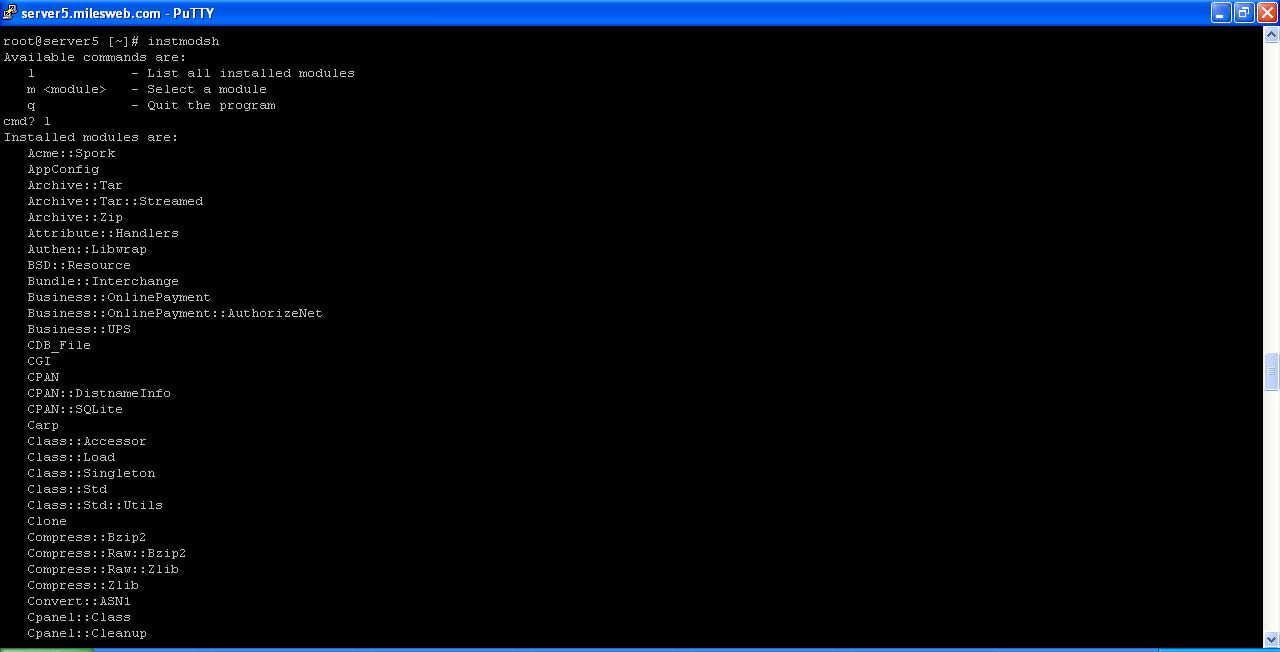
List all installed modules
- Run this command:
perldoc perllocalThis lists modules that were installed from CPAN, which is the big online library of Perl modules. It may be empty if modules came from your system packages.
- For a fuller list, use this command:
find `perl -e 'print "@INC"'` -name '*.pm' -printThis searches all Perl folders for module files. They end with .pm. The list can be long.
- To save the list in a file, add this at the end:
find `perl -e 'print "@INC"'` -name '*.pm' -print > modules.txtThis writes the result into modules.txt.
Using cPanel
If your hosting has cPanel, look for the Perl Modules icon under the Software section. It shows installed modules and lets you search. It is not on every plan. Ask Hostvento support if you cannot find it.
See where Perl looks
perl -e 'print join("\n", @INC), "\n"'This prints the folders where Perl searches for modules.
cpan.Quick recap
- Perl modules are add-ons for Perl scripts.
- Use
perl -MName -eto test one module. - Use
findwith@INCto list all. - cPanel may have a Perl Modules page.